

Have you ever heard about the Summer and Winter Equinox, and never quite understood why it happens? Did you know there was a Spring and Autumn Equinox as well? Ever wondered what the difference between them all is? Well, look no further! Today, we share why these meteorological events happen, and what the difference between them all is.
Every year, we experience the Summer Solstice, Winter Solstice, Vernal (also known as the Spring) Equinox and Autumn Equinox. The Summer Solstice and Winter Solstice have an opposite impact on the Northern and Southern hemisphere respectively, causing either the longest or shortest day of the calendar. The Autumn Equinox and Vernal Equinox results in equal length days across the whole world.
So why does this happen?
The Earth sits on a tilt, known as its axis, on which it rotates. Every planet in our solar system has an axis on which it spins. The Earth’s axis runs on a straight line, starting from the North Pole and ending in the South Pole. Currently, the Earth is sitting on roughly a 23.44-degree angle, but that will change over time. During a cycle that roughly spans around 40,000 years, the Earth’s axis can vary from 22.1 to 24.5 degrees. Because of this slight change in its axis, the seasons as we know them can become exaggerated.
Why do we celebrate each solstice?
We celebrate each solstice because they mark significant astronomical events that have been observed and celebrated by various cultures throughout history. The summer solstice is the day of the year with longest amount of daylight, which for us in the Northern Hemisphere is around June 21st. In contrast, the winter solstice is the day with the shortest amount of daylight, which occurs around December 21st for those that live in the Northern Hemisphere.
Overall, celebrating each solstice allows us to connect with nature’s rhythms, honor the cycles of the seasons, and appreciate the interconnectedness of all life on Earth.
How does it work?
In addition to the Earth spinning on its own axis, it also moves around the sun. This is known as its orbit. Again, all planets in the solar system have an orbit around the sun, and these orbits are elliptical, which means they are a similar shape to an oval.
Depending on the angle that the Earth is on its axis in combination with its position in its orbit around the sun, will determine the amount of daylight different areas of the Earth will receive. This can be seen on the diagram below.
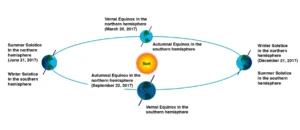
This is why we have longer summer days and longer winter nights in the UK. This also explains why those who live in Australia can have a barbeque on Christmas Day! Whilst we are experiencing long winter nights, they, in contrast, are receiving long summer days over the Christmas period.
Here at Smart 11+ Tuition, we want all our students to skyrocket their confidence all the way into space! Why not share this blog with your child so they can learn more about the world around them and help motivate them to reach for the stars!


